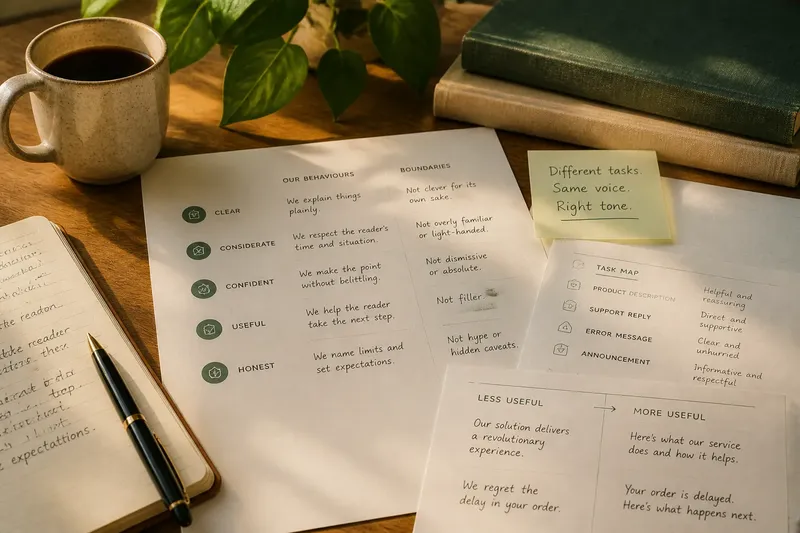
A One-Page Identity Review for a New Project
A one-page identity review helps a new project spot where its name, description and visual mark support or contradict its central idea before launch.
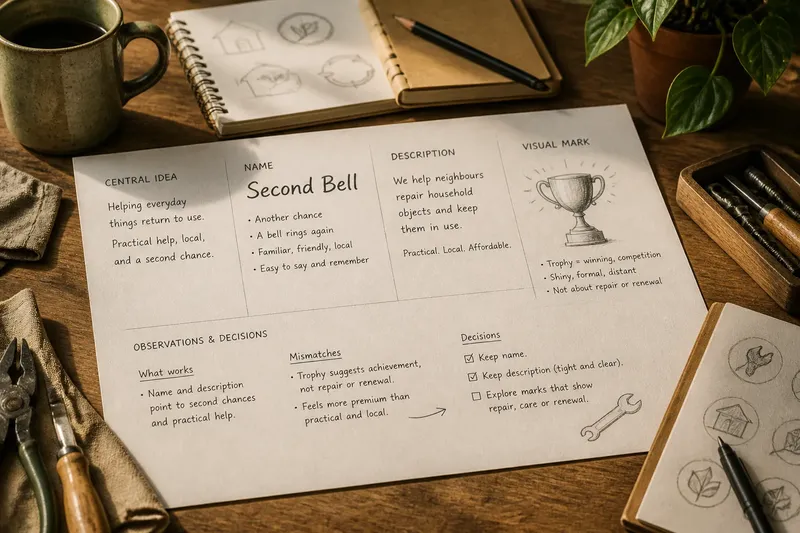
You have a name, a short description and a visual mark, but together they may tell different stories. A one-page identity review puts those parts side by side so you can see what supports the project’s central idea, what distracts from it and what needs a decision before you move on.
This is not a test of whether the identity is attractive or finished. It is a focused reading exercise: describe the idea you want people to recognise, examine the three elements as they currently stand, then note where their signals agree or conflict. The result is a small set of useful decisions, not a score.
What should the one-page review help you decide?
Use the review to ask whether a person encountering the project can connect its name, description and mark to the same basic idea. “Central idea” means the project’s defining promise or point of view, expressed plainly enough to guide choices. It need not be a slogan, and it should not try to include every feature.
Keep the review narrow. Do not use it to judge every colour, write a full messaging system or settle every audience question. Those tasks can obscure the useful comparison: what does each element suggest, and do those suggestions belong together?
Set aside a sheet of paper or a blank document. Give it a title, then make four sections: central idea, name, description and visual mark. A final section for observations and decisions will help you turn the reading into action.
Which situation are you in?
The right review depends on how settled the project is. Choose the situation that fits most closely; there is no benefit in forcing a polished identity out of an unresolved idea.
If the project idea is still changing
Start with the central idea, not the appearance. Write a provisional sentence about whom the project serves, what it helps them do or understand, and what makes its approach distinct. Mark it as provisional if the purpose is still under discussion.
This situation suits a review that exposes open questions rather than producing final design instructions. If the sentence keeps changing as you compare it with the name and mark, record what remains uncertain before revising the visuals.
If the project purpose is clear but the identity is rough
Review the current name, description and mark as they are, even if the mark is only a sketch or a simple shape. You are looking for directional fit, not finish. This is a good point to catch a mismatch before detailed design work makes it harder to reconsider.
Keep any placeholder visibly labelled as such. A polished-looking mock-up can invite feedback about craft when the question is really whether the concept communicates the intended idea.
If the identity is nearly ready to share
Use the page as a final coherence check, then read the elements in the order a newcomer is likely to meet them. Note whether the description clarifies the name, and whether the mark belongs beside both without introducing a competing message.
This review is suited to identifying a last unresolved contradiction, not reopening every settled choice. If a concern does not affect recognition or understanding, put it aside for a separate design discussion.
How do you fill in each part of the page?
Begin with the central idea in one or two direct sentences. Avoid words that praise the project without explaining it, such as “innovative” or “inspiring”. Name the audience or situation where that helps make the idea concrete, but do not turn the sentence into a long list of features.
In the name section, write the project’s actual name and record the associations it may create for someone unfamiliar with the work. Consider its sound, spelling and possible meanings, but do not try to settle naming questions through this exercise alone. The point is to notice whether the name points towards the same territory as the central idea.
In the description section, use the short wording a new visitor might see first: a sentence on a landing page, a line beneath a logo or a brief introduction in a proposal. Ask what a person could reasonably infer from it. If it uses broad language, note what concrete detail would make the project easier to understand.
For the visual mark, place the current symbol, wordmark or rough sketch beside the text. Write down what its shapes, subject and overall character suggest before explaining what you intended. That gap between intention and likely reading is often more useful than a debate over whether the mark is “good”.
Now read the three entries together. The name may set one expectation, the description another and the mark a third. Record specific evidence: a nature-related word paired with a mechanical emblem, for instance, is more useful to discuss than a general note that the identity feels inconsistent.
What should you look for when the signals disagree?
Separate a genuine contradiction from a difference in tone. A calm, plainspoken name and a lively mark might still serve one idea if the project is meant to make a difficult subject approachable. A mark suggesting luxury, however, may conflict with a description centred on low-cost access if both are intended to express the same offer.
Check for four kinds of mismatch:
- Meaning: Does an element suggest a purpose or audience the project does not serve?
- Specificity: Is the description clear while the name and mark remain so abstract that they could belong to almost anything?
- Character: Do the elements imply sharply different attitudes, such as formal authority and playful informality?
- Priority: Does one element make a secondary feature seem more important than the project’s central idea?
Do not assume that every difference needs fixing. An identity can have contrast while retaining a coherent centre. The decision is whether the contrast adds a helpful dimension or makes the project harder to recognise.
How should you act on the review?
Imagine you are developing a neighbourhood repair service called “Second Bell”. Its draft description says it helps residents repair household objects, while the rough mark shows a polished gold trophy. The name suggests another chance, and the description supports that idea; the trophy may instead imply competition or achievement. You could note that conflict, then ask the designer to explore a mark connected to repair or renewal while preserving the name and description for now. The expected observable result is a set of identity elements that point more clearly towards helping objects return to use.
On your page, turn each observation into a decision, not a vague reaction. Write whether you will keep an element, revise it, gather a little more input or leave it open because the central idea itself is unsettled. Add a brief reason so another collaborator can understand what the decision is meant to protect.
Change one element at a time when you can. If you rewrite the description, rename the project and replace the mark together, it becomes difficult to tell which change addressed the mismatch. A focused adjustment gives the team a clearer basis for discussion.
When several people review the page, ask each person to write their first reading before discussing intent. This reduces the chance that a confident explanation from the project owner will shape everyone else’s interpretation. Compare notes for patterns, but treat disagreement as a prompt for clarification rather than a vote on taste.
What questions help finish the review?
How long should the central idea be?
Keep it short enough to compare with the name, description and mark at a glance. One or two plain sentences are usually easier to use than a paragraph full of qualifications.
Should the visual mark be finished?
No. A sketch or clearly labelled placeholder can help you assess its subject and character. Keep the review focused on what it communicates, rather than polish that has not yet been developed.
What if the name has several possible meanings?
Record the readings that seem plausible to someone encountering it without explanation. If those readings pull in different directions, note whether the description can clarify the intended one or whether the name itself needs further consideration.
Can the elements deliberately send different signals?
They can use contrast, but that contrast should still make sense beside the central idea. If a difference feels purposeful, write down what it contributes so collaborators can distinguish it from an accidental mismatch.
When is the page ready to put away?
Finish when the page has a clear central idea, a first reading of each element and a short list of decisions or open questions. It does not need to prove that the identity is perfect. Its value is that the team can say what it intends to communicate and point to the parts helping or hindering that intention.
Keep the one-page identity review beside the next draft, not as a permanent rulebook but as a record of the reasoning behind the choices. If the project’s purpose changes, revisit the central idea first; the name, description and visual mark may then need a fresh comparison.
Before sharing the identity, ask one person who has not heard the project explained to read the name and description and look at the mark. Ask what they think the project is about, then compare their answer with the central idea on your page. That small check can show whether the identity communicates on its own, rather than only after its creators fill in the gaps.