The Quiet Work of a Brand Voice Guide
A brand voice guide turns a few language principles into clearer choices, helping teams write distinct messages without forcing every sentence into one template.
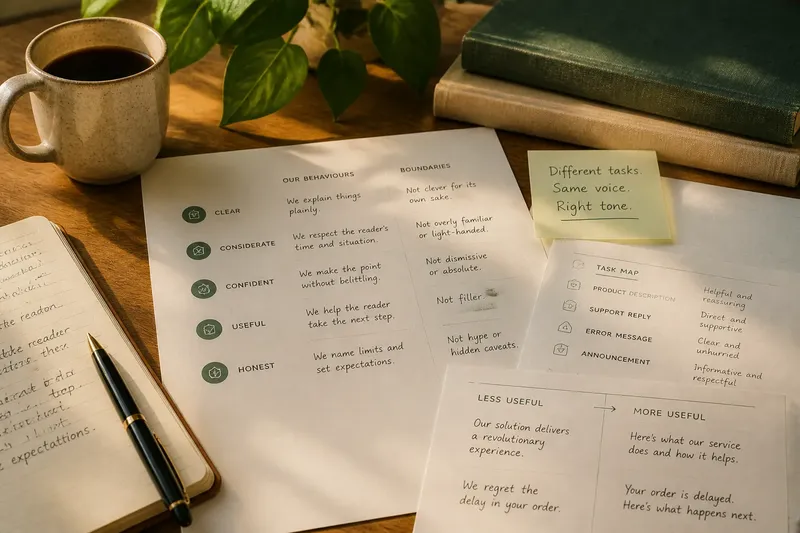
A brand voice guide helps when a customer email, product label and social post sound as if they came from different organisations. The answer is not to make every sentence alike, but to agree on language principles that guide writers across situations.
A useful guide gives reasons, not scripts. These seven elements offer shared direction while leaving room for the message, audience and moment to shape the words.
1. Define the voice through behaviour, not adjectives
Words such as “friendly”, “bold” or “approachable” are too broad to guide a draft on their own. One writer may interpret “friendly” as chatty; another may add exclamation marks. Describe what the voice does instead: explains unfamiliar terms plainly, acknowledges a reader’s concern, or makes a recommendation without pretending there is only one right choice.
These descriptions turn personality into observable writing. “Clear” might mean putting the action before the background, while “considerate” might mean naming a limitation before asking someone to proceed.
Choose a small set of behaviours that express the organisation’s character, then define each in everyday language. A principle is useful when two writers can discuss whether a passage follows the same intention.
2. Pair each principle with a boundary
A voice principle becomes more precise when it also says what not to do. “Warm” could mean addressing the reader directly, but it need not mean using pet names or treating a serious problem as light-hearted. The boundary protects the intention from an overly literal reading.
Make the boundary specific enough to influence a real edit. “Confident, not dismissive” may mean explaining a decision without belittling questions; “playful, not obscure” may mean allowing a small joke while keeping instructions easy to follow.
Boundaries also prevent principles from competing. If a brand values both brevity and reassurance, the guide can clarify that writers should not remove the sentence explaining what happens next simply to make copy shorter.
3. Show how the voice changes with the task
A consistent voice does not require an identical tone in every message. A welcome note can be lively; a service update about a delay may need restraint. Voice is the recognisable set of language habits, while tone is the adjustment made for a particular situation.
Map recurring tasks against the principles: a product description, an error message, a support reply and an announcement. For each, explain which behaviours should remain and what should shift. A support reply might keep direct, plain language while setting aside humour because the reader needs help.
Say a small outdoor-equipment shop wants to sound capable but never superior. In this invented situation, a customer asks whether a jacket suits a damp walking route. The writer explains what the fabric is designed for, names its limits in ordinary terms and invites the customer to check the care label; the expected result is useful guidance without a boast or an unsupported promise.
4. Set useful choices for words and sentence shape
Some consistency comes from small, repeatable decisions. A guide can state whether the brand addresses readers as “you”, prefers everyday verbs over corporate nouns, or explains specialist terms the first time they appear. These choices reduce needless variation without prescribing a whole paragraph.
Sentence guidance should leave room for emphasis. “Prefer short sentences” can produce clipped, monotonous copy if treated as an absolute rule. A better principle might be to keep instructions direct and use a longer sentence when the relationship between ideas needs explaining.
Include examples of the choice, not a catalogue of approved phrases. If the brand avoids inflated claims, show how to replace “revolutionary solution” with a concrete description of what the service does. Writers can then apply the reasoning to new material.
5. Treat examples as demonstrations, not scripts
Examples are especially helpful when they show a meaningful contrast. A short “less useful” line followed by a clearer alternative can reveal that the issue is an unsupported claim, an unexplained term or a tone that ignores the reader’s concern.
Explain the reason beneath the change. Without that explanation, writers may copy the replacement phrase into a different situation where it does not fit. A guide should teach the judgement behind the edit, not make the team search for a matching sentence.
Use examples from different formats so the principles do not appear tied to one channel. A line on a box, a service email and a page heading can share plain language while taking different shapes.
6. Keep the guide close to the writing
A polished document is of little use if writers cannot find it while drafting or reviewing. Keep the guide in the team’s normal working space, use clear headings, and make the principles easy to scan. Link detailed wording conventions separately if they would distract from the central guidance.
Review the guide when a new kind of message repeatedly raises the same question, or when people interpret a principle in conflicting ways. Update the explanation and its examples rather than adding rules for every isolated sentence.
7. Give the guide clear ownership and a review habit
A named editor or small group can keep the guidance coherent as products and communication needs change. Invite writers and customer-facing colleagues to raise unclear points, then revise the guide when an actual decision exposes a gap.
For instance, imagine a support team notices that writers interpret “be concise” differently in replies about delayed orders. The editor compares the guidance with the messages, clarifies that a reply should still explain the next action, and adds a brief before-and-after example; the expected result is a shared editing standard without dictating every response.
The quiet work of a brand voice guide is to make decisions easier before copy reaches approval. A few precise principles, clear boundaries and context-aware examples can help different writers sound related while still writing for the message in front of them.
When reviewing a draft, ask whether its choices express the intended behaviour and suit the reader’s situation. That question keeps a brand voice guide useful without turning it into a sentence-making machine.